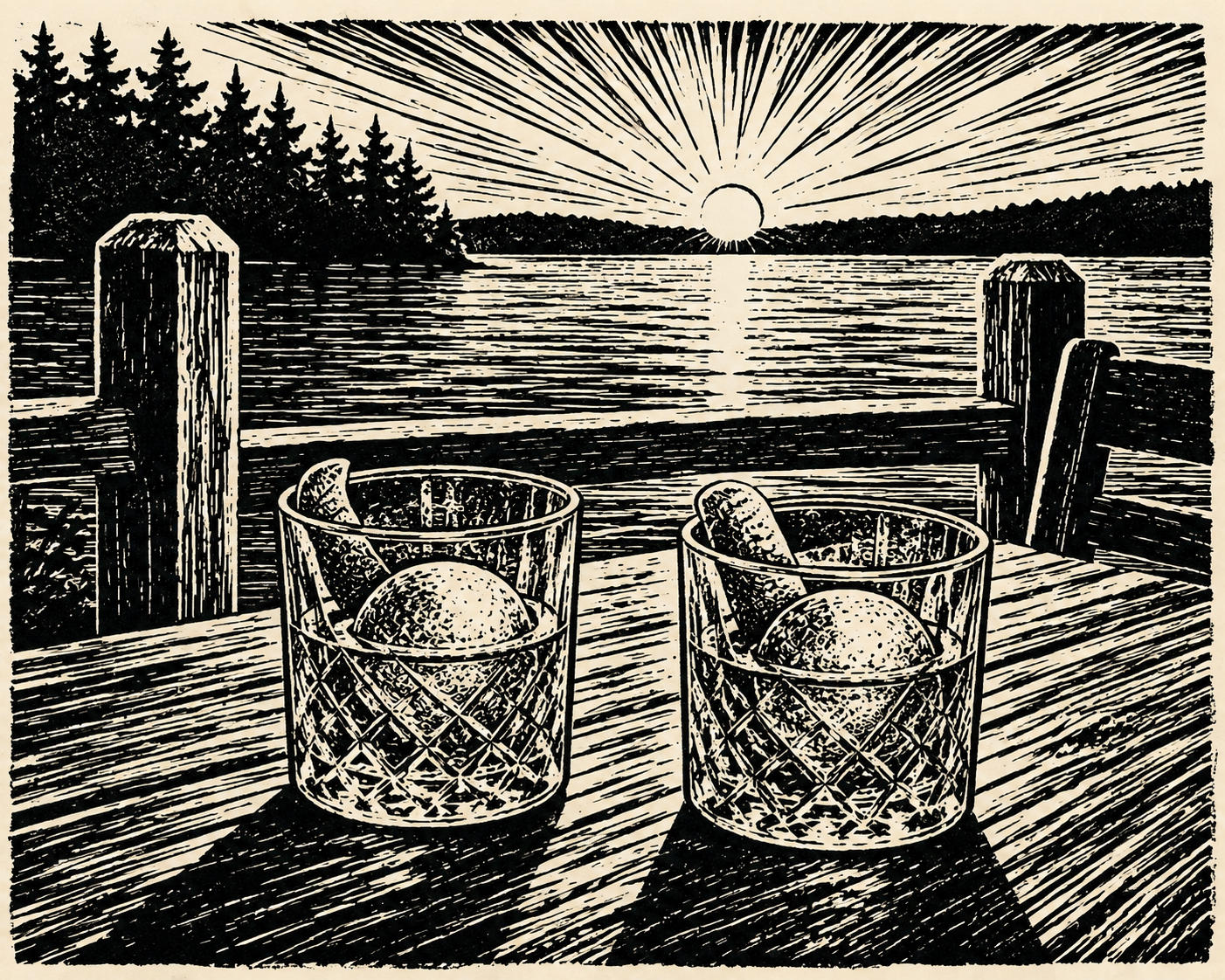
The sun was going down and there were drinks and my colleague had just started a new job. We were outside somewhere, talking about next moves, the way people in their mid-thirties sometimes do when enough has accumulated that the next thing actually needs thinking about.
Somewhere in the conversation I turned the PhD program over in my mind. It is the logical next move in higher education — in the work I’ve been doing for years, helping students find the right schools, navigate applications, figure out what comes next. The PhD is what comes next, for me. Obvious. Reasonable. And sitting there with my drink and the last of the light, I felt something I can only describe as quiet absurdity. Not dread. Not resistance. Just the mild absurdity of doing the thing because it is the thing that comes next.
My colleague felt something similar about his move. We didn’t say it directly, but it was in the air: we had both built something, and we weren’t entirely sure we were the ones who’d built it.
What the Job Carries
I’ve worked in college admissions for 14 years. I help students answer one of the questions at the center of their lives: what do you want to be? It is the question underneath every application, every essay, every school visit. And for a long time my own answer to that question was: this. The work. The field. The title.
It happened gradually. When my kids were young and the financial stakes got real, I set aside the parts of me that didn’t contribute to the earning. I had spent years before that in theater, in performance, in the kind of creative work that doesn’t have a clear economic output. None of that went anywhere specific. So I set it down. Not dramatically. Just practically. There wasn’t time, and there wasn’t margin, and the job was there and real and needed doing.
The job was good. I was good at it. It filled the available space.
What I didn’t notice until much later was how completely it filled the space. The question I spend my days helping prospective student navigate, I had answered, for myself, with a job title. And that had felt like enough, for a while, because it mostly was.
The Mechanic and the Think Tank
Matthew Crawford has a PhD in political philosophy from the University of Chicago. He took a job at a Washington think tank and left after five months to open a motorcycle repair shop.
In his book Shop Class as Soulcraft, he describes the difference between how people responded to each answer when they asked what he did. “Think tank” bought him a few seconds while he tried to figure out how to explain what he actually did. “Motorcycle mechanic” got immediate recognition. People knew what it meant. They could picture it. There was something real there.
He writes that there was more thinking going on in the bike shop than in the think tank. Not because the work was intellectually harder, but because the bike pushed back. It had opinions. The carburetor worked or it didn’t. The engine turned over or it didn’t. There was no room to paper over the gap between what he thought and what was actually true.
Crawford’s argument is not that everyone should quit their job and go work with their hands. It’s that we’ve built an economy that has systematically devalued the making, the physical, the craft out of what counts as real work. That devaluation has cost us something we can’t quite name but can feel. The parts of us that want to engage with the physical world, to make something real, to hear the world push back: they’re still there. We’ve just stopped feeding them.
The Thing You Try to Monetize
For years, when creative work came up, and it always does, I tried to run it through the same test I’d run a job through. Could it make money? Did it have a market? Was there a version of this that would justify its existence?
But this is the wrong move and it took me longer than it should to have seen it.
When you monetize something you make, the relationship changes. What was yours becomes contingent on someone else’s judgment about its value. What was play becomes work. The brain recategorizes it. You stop doing it for the reason you loved it and start doing it for the reason(s) someone else might fund it. And slowly the thing hollows out.
Creative work isn’t valuable because it can produce income. It’s valuable because I do it, and it’s part of who I am. And that is, and I’m still getting used to this, enough.
The Car
I am rebuilding a 1969 Mini Cooper S with my son. It is expensive. The parts are hard to find. We are not going to make back what we put into it.
We do it anyway.
I am not sure I have a cleaner argument than that. Crawford spent a whole book building toward what we’re doing in the garage whenever we can find the time. The car pushes back. It has problems we have to solve. There is grease and there is confusion and there are parts that don’t fit right and have to be refigured. And when something works, it is because we made it work, not because we talked about making it work, not because we planned it out on paper, but because we were there with our hands on the thing until it did what it was supposed to do.
My son is learning something I can’t teach him directly. Something I’m still learning it myself.
What I’m Still Working Out
The PhD is still out there. The next career move is still out there. I haven’t resolved any of that.
What has shifted is something quieter. The job used to have to carry all of it. Who I was, what I was worth, what I had to offer. Now it doesn’t. It’s part of the picture, a real part. It’s work I take seriously, but it’s not the frame.
I don’t know exactly what to call what’s happened. I’m not sure I need to.
Some questions I’m sitting with: What do you lose when your job has to carry all of what you are? What parts of yourself are waiting quietly in the background of a life that’s been fully optimized for output? And what would you call yourself if how you made money weren’t part of the answer — would that person surprise you?